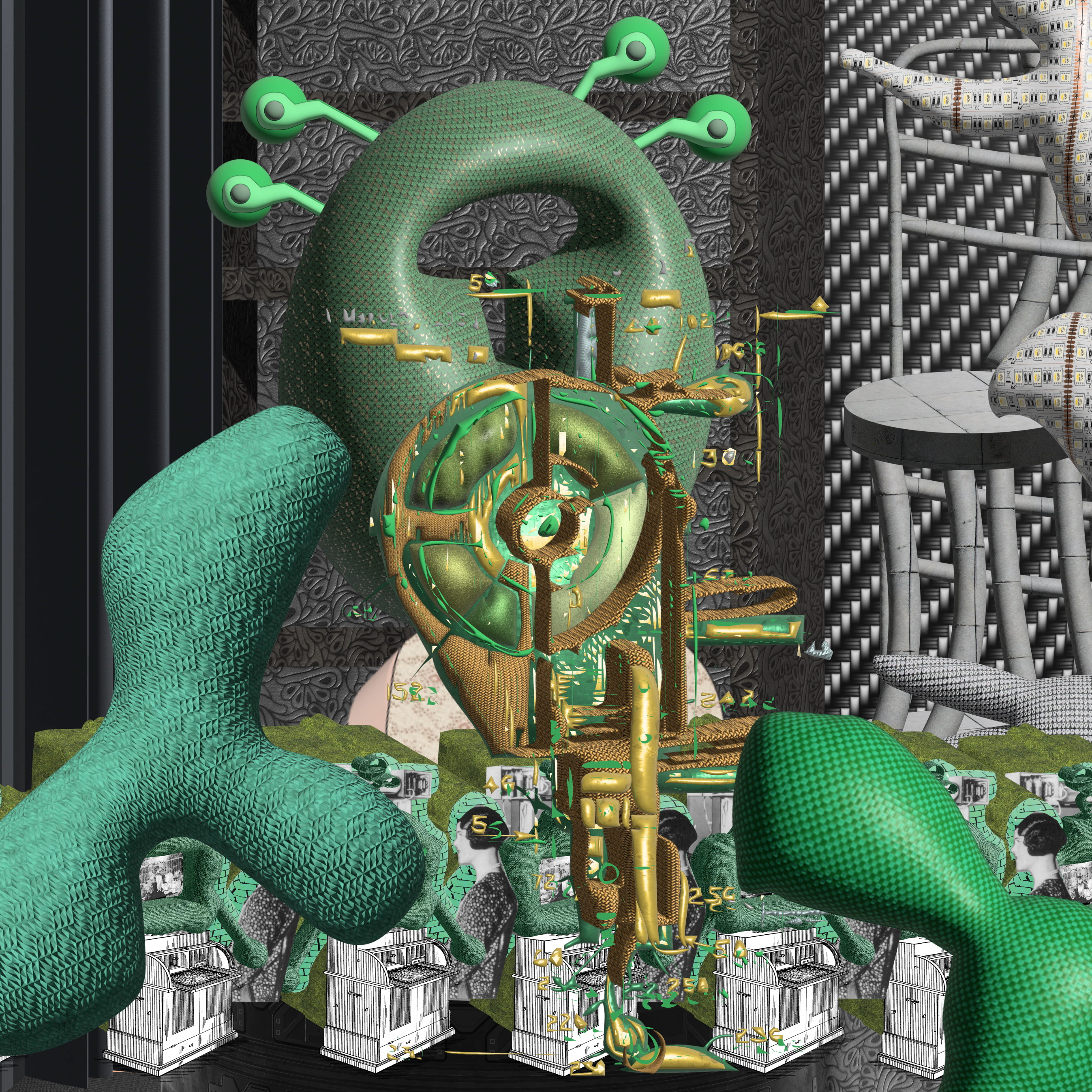
The Boring Machine with Pocket and Tire Gauge and Cotter Pins and Curtain Clamps and Bobby Pins

Plushies are all the rage with kids these days; the artist’s kids love them. No wonder! They are squishy, soft, playful, cuddly, and huggable, so important in inventive children’s play. Doll-like artifacts have been found dating back to 3000–2000 BC as an imagination-inspiring source of social and emotional learning, creativity, and the play that is so necessary for healthy human development. AND, someone had to make the dolls! Dolls have been made by children and adults. Doll making and manufacturing connects to the work of women, historically and presently.
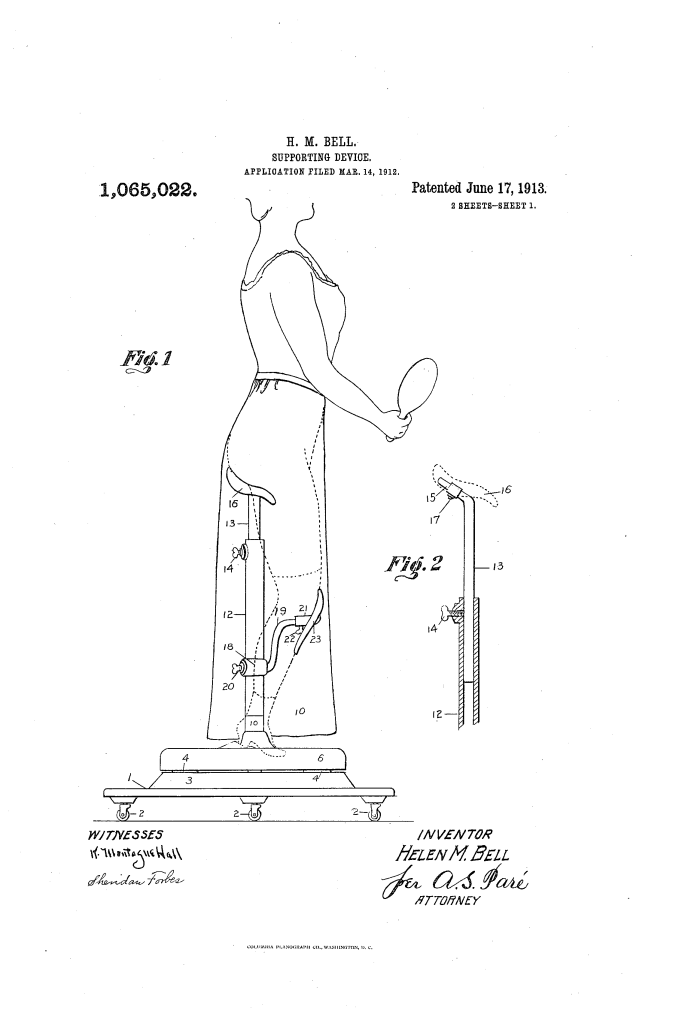
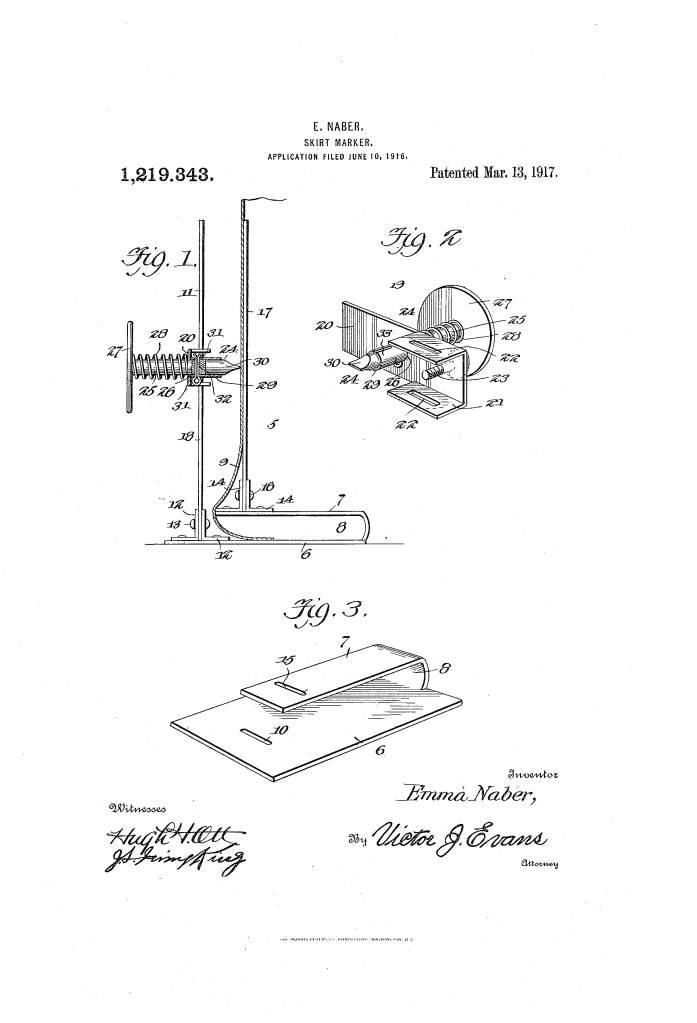
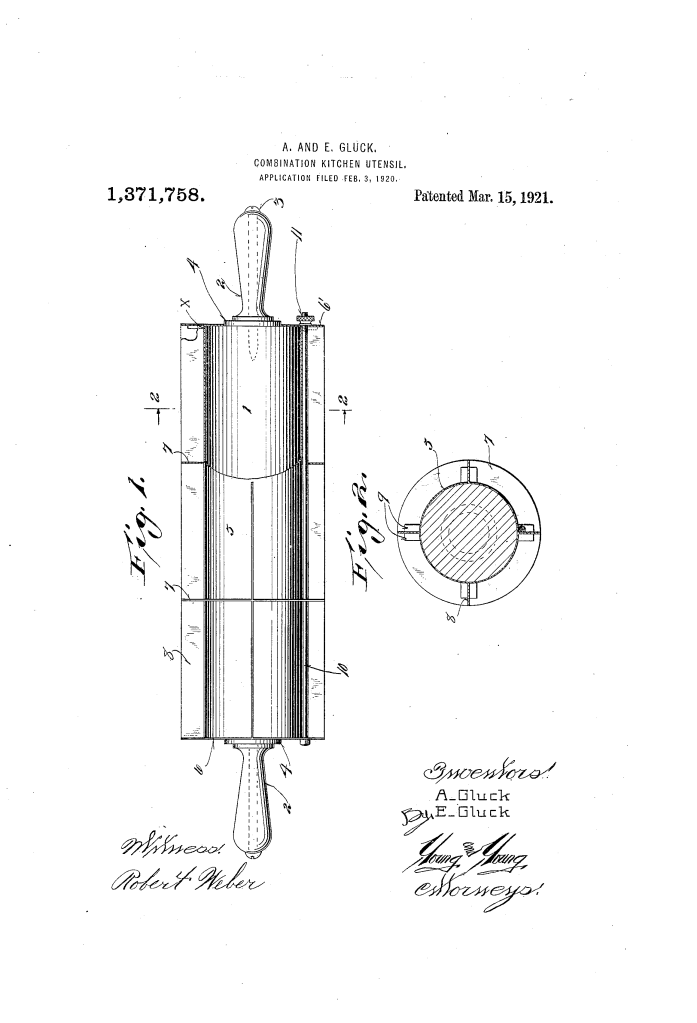
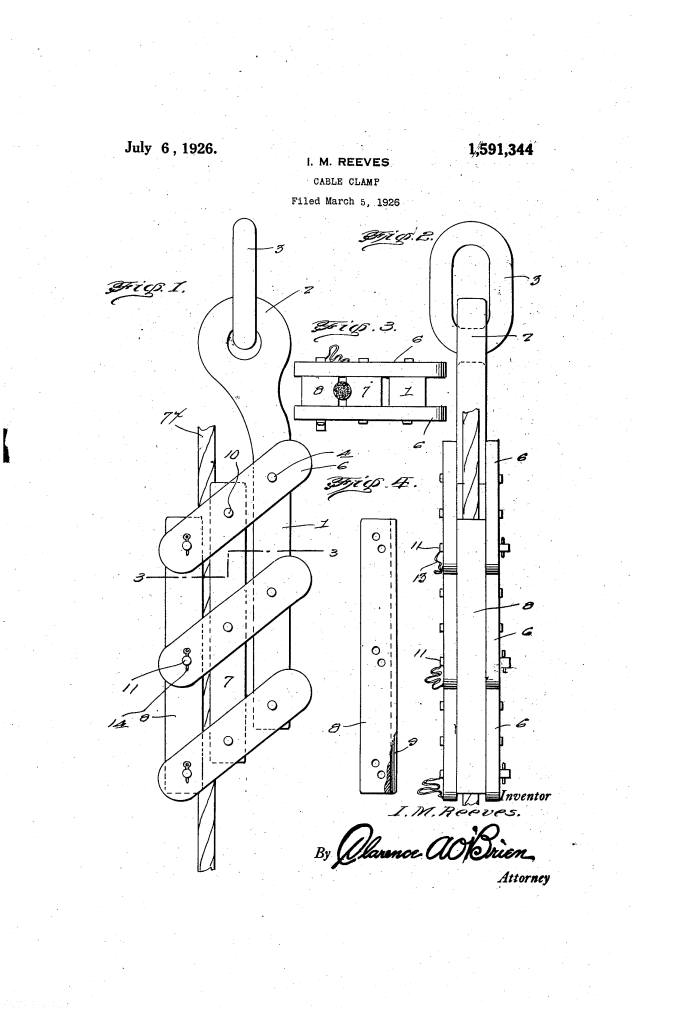
For these Patent Plushies with Pockets, the artist used imagery of patents by women as a starting point, and then the geometric/mechanical-like shapes were translated to 2D shapes that were cut out of fabric (originally designed by the artist) and then sewn into pillow-like plushy forms. Improvising with these forms yielded biomorphic forms. Adding mechanical, metal components found in historic photographs of women working with manufacturing and building technologies brings an unexpected hardness to the otherwise soft, squishy forms. Each has a pocket that holds important items, referencing the politics of pockets related to women’s clothing.
The plushies are presented on doll stands like children’s playthings. The artist muses that her kids “can make dolls out of anything” and that they find these forms to be “cute” and deserving of empathy and care and want to play with them and their hair like “my little pony”.
For the artist, making them has been akin to caregiving, a process that is a sort of metaphor for her caring for her children and caring for herself when ill. Caregiving is work that is almost 99.9% improvisation as every minute requires flexibility, adaptability, and fluid inventiveness. This process is mimicked in the process of making these plushies. Adding to and removing elements from them, disentangling their parts from hers (hair from her fingers and their other poky parts), trying to devise ways to attach different parts whose shapes do or don’t fit together, using fasteners and connectors, sewing, stitching, containing, letting loose, wrangling and letting go, fixing and knowing when to not fix, holding things in pockets, letting things stick out, openings, closings, combining, cutting, layering, fraying, mending, ripping, stitching.
In order to make them, it requires lots of mending, improvised sutures, hair braiding, sharp pokes with needles and metal, lots of fine motor hand-work (a particular challenge for the artist as her fine-motor skills have been negatively impacted by the medication she takes to keep her cancer from recurring). They are fragile and sharp, protected and vulnerable, organic and mechanical, soft fabric and hard metal, curvy and poky, they fasten and connect, while letting parts stick out and unhinge.
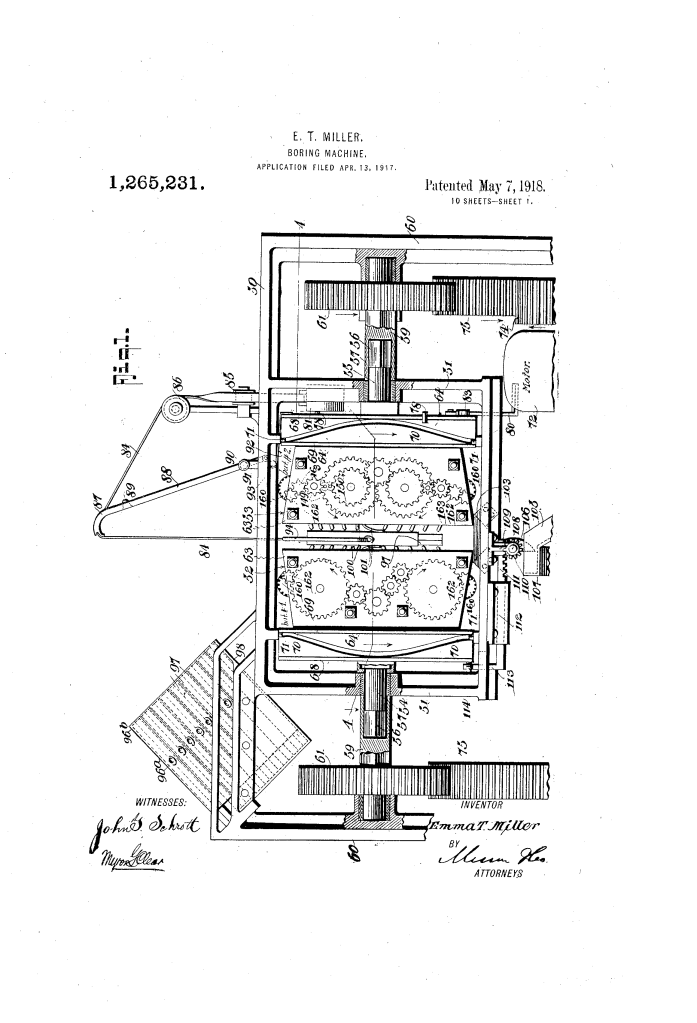
Emma T Miller ● Patent US1265231A ● 1918 ● Boring Machine
Be it known that I, EMMA T.-l\I1LLER, a citizen of the United States, and a resident of San Antonio, in the county of Bexar and State of Texas, have invented a certain new and useful Improvement in Boring-Machines, of which the followingis a specification. I
My present invention relates generally to boring machines, and more particularly to machine for boring brush blanks, my primary objectbeing to provide a machine which will bore all of the necessary openings, both straight and at an angle, at a single operation. I i
Among the various other objects of the invention, I aim to provide a pair of relatively movable boring heads, each having a battery of’bits, together with means whereb to so move the short bits as to cause quic clean. movement. of the same into the blanks.
Another obiect is to provide relatively movable boring heads, together with means controlled by the movements of the head, for automatically feeding I blanks therebetween.
A still further object of the invention is to provide simple and effective means for discharging the bored blanks and disposing’of the chips or cuttings.
Furtherobjects and the advantages of my invention, will be better understood from the following description thereof, in which reference is made to the accompanying drawin s formin arts of this s )ecilication and wherein- Figure 1 is a partial side elevation, portions being broken away and in section.

War production workers at the Heil Company making gasoline trailer tanks for the U.S. Army Air Corps, Milwaukee, Wis. Mrs. Angeline Kwint, age 45, an ex-housewife, checking the tires of trailers. Her husband and son are in the U.S. Army
Image Description ● Library of Congress ● 1943 ● Farm Security Administration – Office of War Information Photograph Collection (Library of Congress)
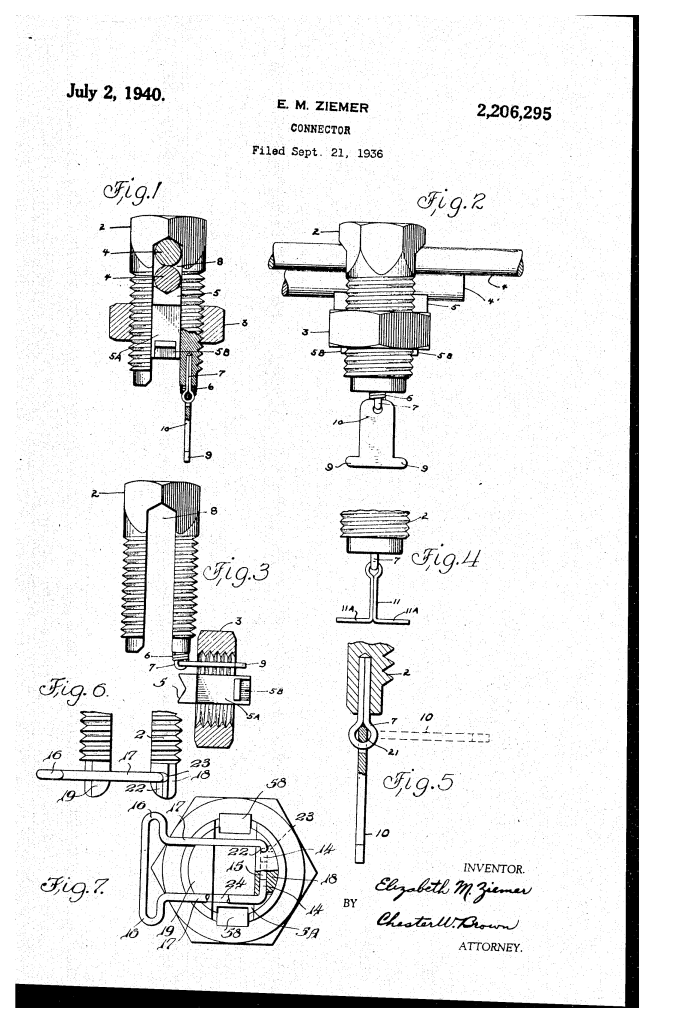
Cotter Pin-Related Patents
https://patents.google.com/patent/US2206295A
https://patents.google.com/patent/US1065022A
https://patents.google.com/patent/US1371758A
https://patents.google.com/patent/US1219343A
https://patents.google.com/patent/US1820899A
https://patents.google.com/patent/US959670A





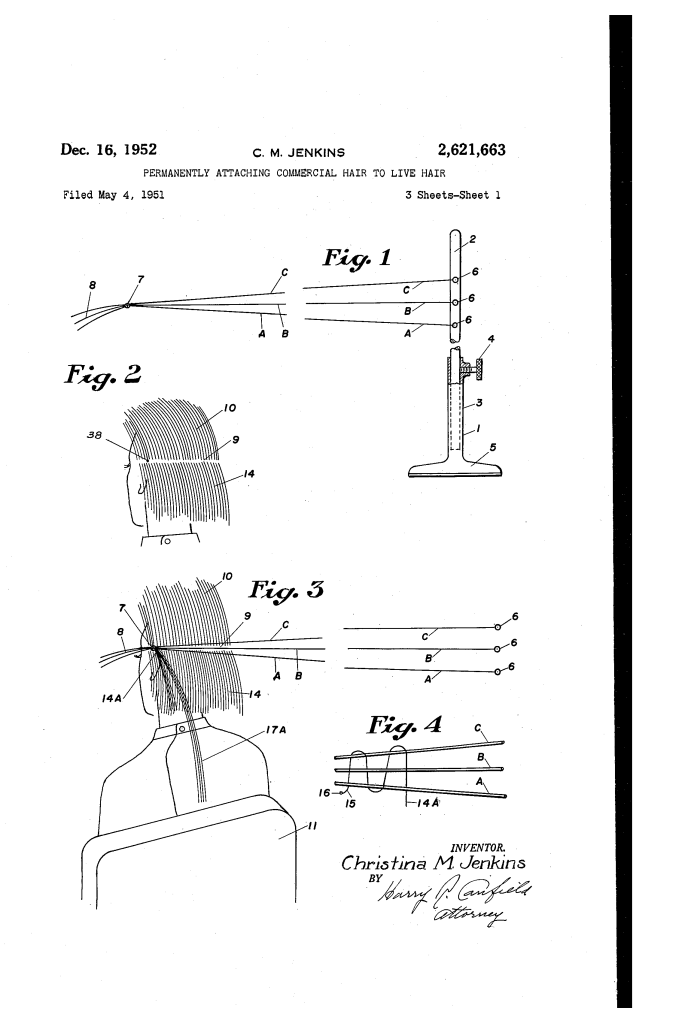
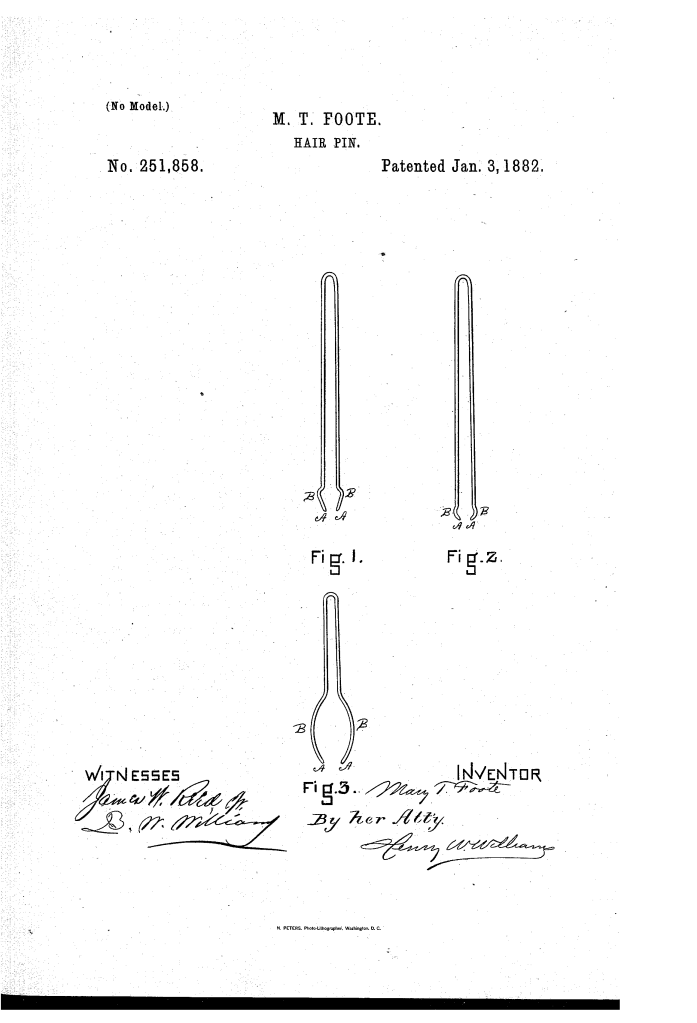
Christina M Jenkins ● Patent US2621663A ● 1951 ● Permanently attaching commercial hair to live hair
https://patents.google.com/patent/US2621663A
This invention relates to the art of applying commercial hair to the human head to supplement live hair thereon.
The invention is embodied in a method and apparatus by, which commercial human hair can be securely attached to the live hair on the head and the means of attachment, and the zone of attachment, rendered invisible. The commercial hair is permanently attached by, the practice of the invention and can be cleaned, waved, etc., on the head, the same as if it were live hair; but if for any, reason it…should become desirable, the commercial hair can be detached and removed.

Christina M Jenkins ● Patent US3280826A ● 1963 ● Hair Piece and Method of Permanently Attaching Same
https://patents.google.com/patent/US3280826A
This invention relates to a hair piece and more particularly to a hair piece composed of commercial or false hair adapted to be applied to the human head by securing the same to existing live hair.
There has been disclosed in my prior patent, US. Patent No. 2,621,663, a method of permanently attaching commercial hair to the live hair on the head. Broadly, this method contemplates mounting on the head a base of attachment for the commercial hair by interweaving strands of live hair with a base material and then attaching a switch, weft or like accessory of commercial hair to the base. With this method, the commercial hair is permanently attached to the live hair and serves to give the live hair the appearance of greater length and thickness as well as cover bald spots, thin spots, or scars.
Satisfactory as the above-described method has been, it has required the aid of an additional person in order properly to attach the hair pieces. Thus, it has been necessary for the wearer not only to have assistance in obtaining the initial attachment of hair, but also in obtaining periodic tightenings wherein the commercial hair is removed and reattached close to the scalp.
Aside from the requirement of an additional person to attach the hair, the prior known methods have included the formation of a base member which is attached to the live hair by a weaving process. Such a step is tedious, time consuming, and expensive, particularly since the base member must be removed and rewoven periodically as the live hair grows causing the base member to be separated from the scalp.
Accordingly, it is an object of this invention to provide a hair piece accessory which may be permanently attached to the head with greater ease, less expense and less time than was heretofore possible.
Another object of this invention is to provide a hair piece which may be permanently attached directly to the live hair on the head.
It is still another object of this invention to provide a commercial hair piece having clip fasteners which may be secured to the live hair on the head thereby permanently to attach the hair piece to the head.
It is a more specific object of this invention to provide a commercial hair accessory comprising a weft of commercial hair, singularly or folded upon itself a plurality of times, and having a plurality of fastener clips secured thereto.
It is another specific object of this invention to provide a plurality of folded hair pieces secured side by side and having fastener clips secured thereto for permanent attachment to the live hair on the head.
It is a still more specific object of this invention to provide a commercial hair accessory having a plurality of folded layers and a base portion formed by stitching successive layers together with the base portion serving as a base for fastener means which are attached thereto and adapted to be removably secured to the live hair on the head.
It is a further object of this invention to provide a hair piece comprised of a weft of commercial hair, folded upon itself a predetermined number of times with successive layers of the weft being secured to the preceding layers by rows of stitches, and with the stitched portion forming a foundation on which are secured fastener clips adapted to be attached to the live hair on the head.
3,280,826 Patented Oct. 25, 1966 “ice It is a still further object of this invention to provide a method of making a hair piece adapted to be attached to the live hair on the head.
It is another object of this invention to provide a method for fabricating a commercial hair piece comprising the steps of folding a commercial weft upon itself, stitching the folded weft, refolding the weft, and restitching the newly folded portions and continuing the above folding and stitching thereby to form a laminated hair piece with the stitched portion forming a foundation for receiving clip fasteners.
 !!! techn010ffspring !!!