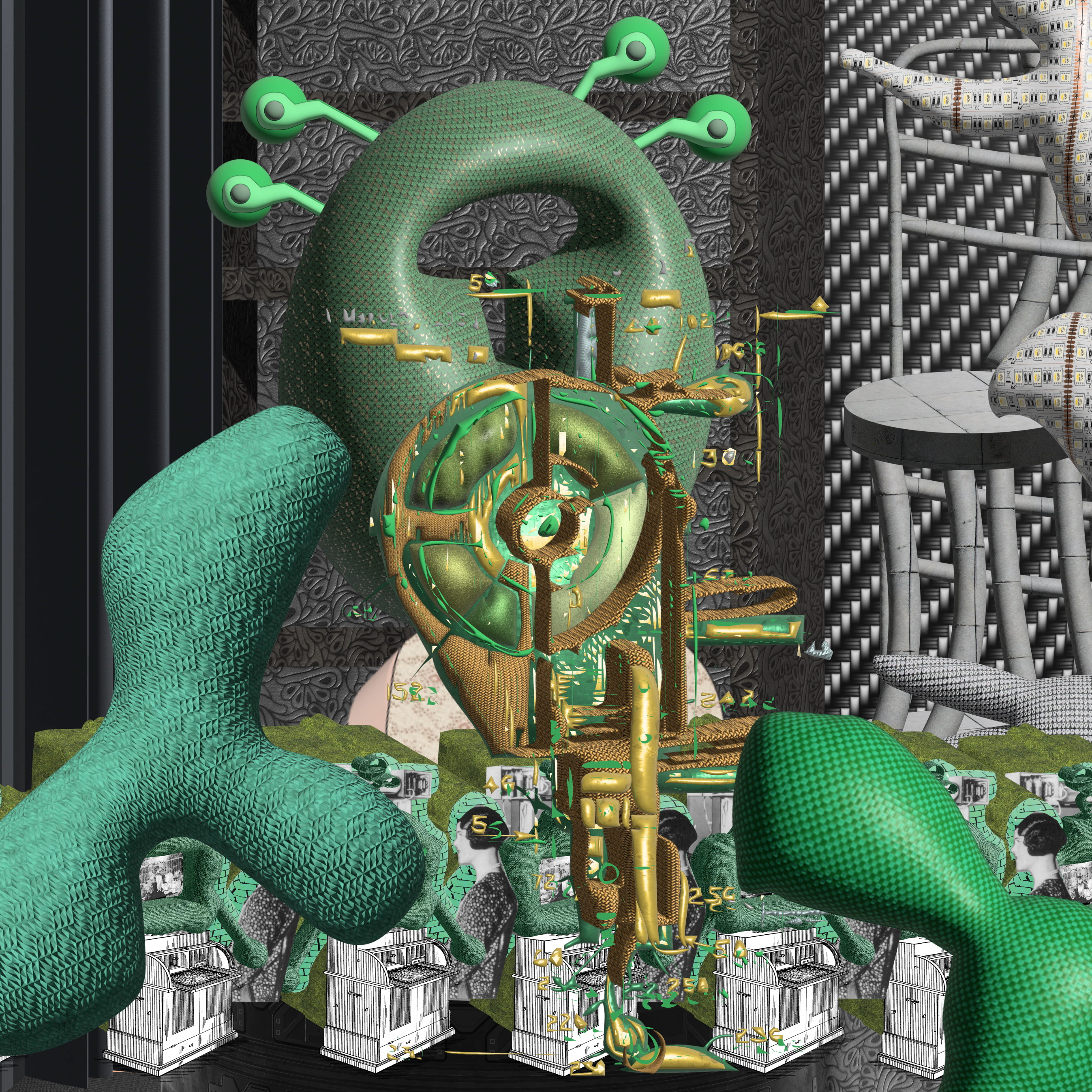
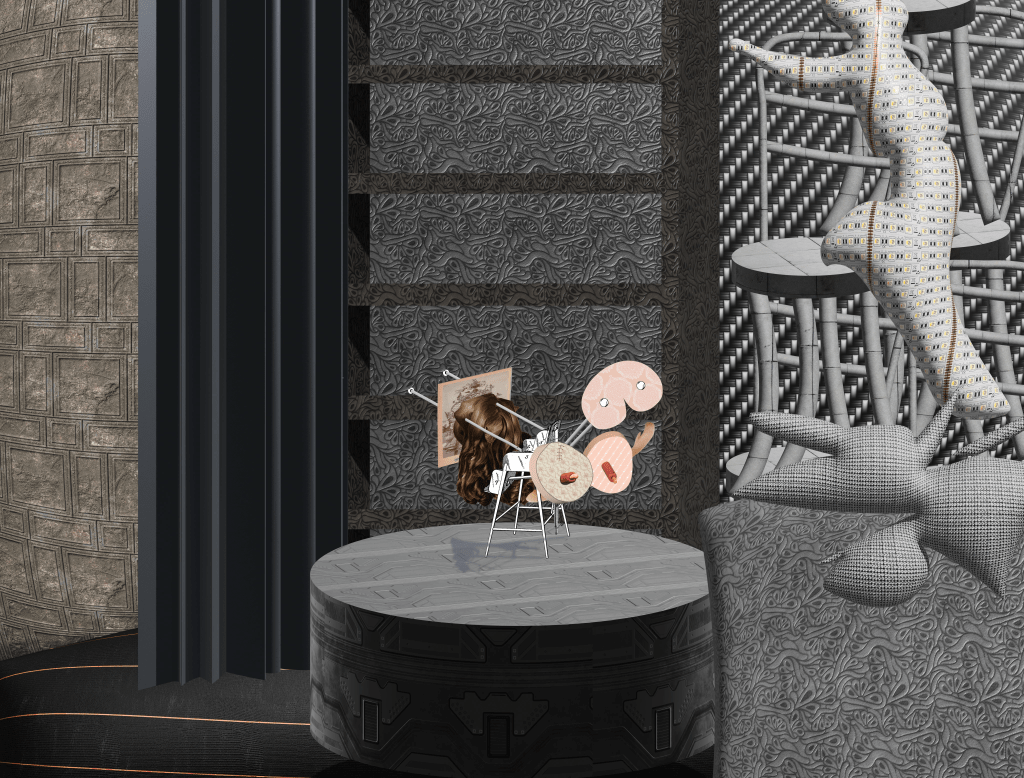


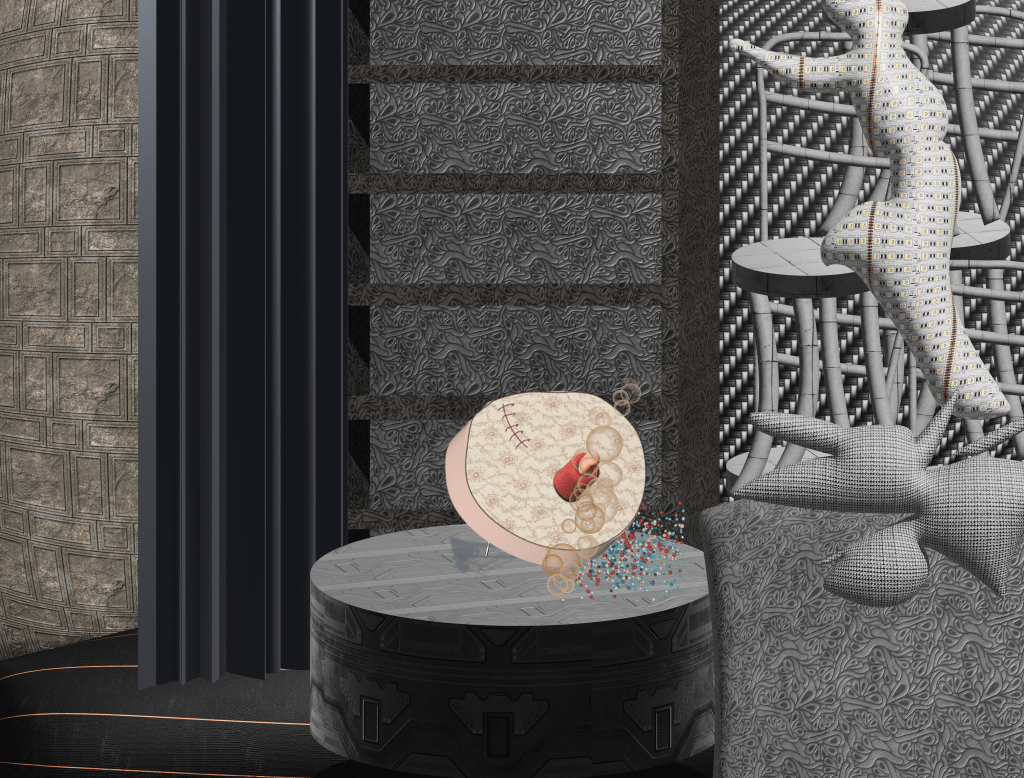


This proposed technology will provide the viewer with emotional labor. The technology includes hair, breasts, a bottom, an old photograph, a patented high chair, a reaching doll hand, a flying car-bus, and a rainbow. Things will explode and become sparkles and shatter and become colorful floating balls. There will even be bubbles!
Women have the meta-common knowledge that we/they perform the majority of the emotional labor in the world (see links below). This technology just helps us out a tiny bit:)
With this in mind, these technologies assemble the ideas from inspiring creative women thinkers and makers in a sort of technological idea montage. In so doing, the technologies can be seen as a community of women’s creative work that makes visible the often invisible work of women, both paid and unpaid.

Interactive Game
Play a new game in which you can rock-a-bye the !!! techn010ffspring [v.1] named [lea-and-the-ball-of-wool-lumpechtomy-with-carriesbrower-high-chair-for-butt-grab-that-is-pooping-clara-fords-electric-flying-car-is-an-unproductive-solution-for-emotional-labor] [v.1] by clicking your mouse or tapping your phone.
This game works in a similar way as the earliest forms of analog animation. As Rebekah Modrak states in her book and on her website, Reframing Photography, thaumatropes (an early form of animation) “ depend on the persistence of vision to blend individual images, thereby creating the illusion of continuous motion.” In this case, single images randomly appear in our frame of view, one-after-another, thus making it appear that the being is toddling.
Link to Rebekah Modrak’s, Reframing Photography, with examples of artists making thaumotropes. https://www.reframingphotography.com/page/photographic-thaumatropes
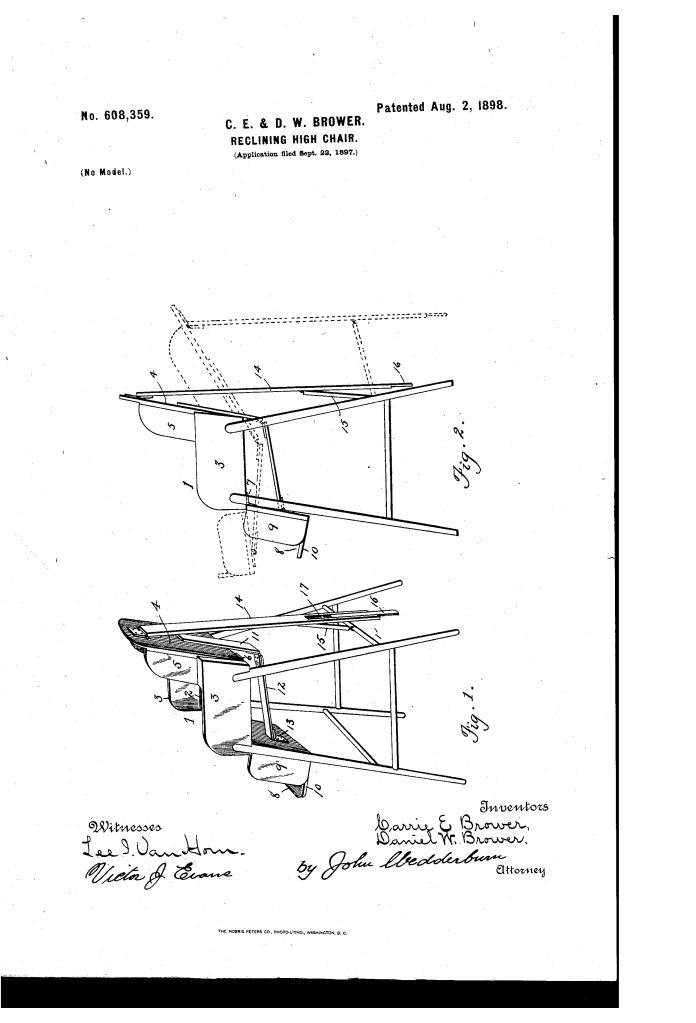
Carrie E. Brower. 1897. High Chair
[I1] Carrie E. Brower & Daniel W. Brower ● Patent #US608359A ● Patented August 2, 1898 ● Reclining High Chair ● “This invention relates to novel and-useful improvements in reclining high-chairs; and it has for its object to provide a chair of the character mentioned that can with very little labor be adjusted and readily converted from a high-chair to a chair in which the child or baby can comfortably rest or sleep.”
To all whom it may concern.- Be it kn own that we, CARRIE E.BRowER and DANIEL W. BROWER, residing at Paterson, in the county of Passaic and State of New Jersey, have invented certain new and useful Improvements in Reclining High-Chairs; and’we do hereby declare the following to be a full, clear, and exact description of the invention, such as will enable others skilled in the art to which it appertains to make and use the same. I i
This invention relates to novel and-useful improvements in reclining high-chairs; and it has for its object to provide a chair of the character mentioned that can with very little labor be adjusted and readily converted from a high-chair to a chair in which the child or baby can comfortably rest or sleep.
A further object of the invention isto provide a chair of this character-that’will be especially simple in construction, cheap, and durable.
WVe are enabled to accomplish the objects of our invention by the simple means illustrated in the accompanying drawings, in which- Figure 1 is a perspective view of a chair embodying our invention. Fig. 2 is a side elevation thereof, the same being shown adjusted to position for reclining therein in dotted lines.

Lea e il gomitolo (Cines, 1913)
[A1] “Lea and the ball of wool.” (Lea e il gomitolo) ● Italian silent film by Cines ● 1913 ● Comedic black & white silent film starring Lea, who likes to read but her parents prefer that she knits. Shenanigans ensue as she tries to locate the missing ball of yarn that is, unbeknownst to her, stuck to her bottom. In her uproarious frantic search, she completely wrecks the house making a disastrous mess of the entire domestic space.
The setting for the machine is derived from the silent film, “Lea and the ball of wool. (Lea e il gomitolo).” (Cines, 1913) as discussed in the book by Maggie Hennefeld, “Specters of Slapstick and Silent Film Comediennes”. I am inspired by Hennefeld’s description of the main character as having “wild corporeality” (p. 86) and how Hennefeld places her in the category of “Revenge Seekers: Like adult versions of the adolescent prankster characters, these women perform comical-destructive antics that are motivated by their overriding desires for revenge” (p. 91).
Historic Photograph of Children
Relatives
[C1] Photograph of unknown children relatives.


FLYING CARS & THE 1914 ELECTRIC CAR OF CLARA FORD
All of these famous entrepreneurs are always talking about flying cars…. If created, who will these actually benefit? What if we instead consider flying buses to take our children to school? How joyous would that be???!!!!
And why did we not have electric cars until recently, when they are much better that gas cars in many ways? The car pictured here is the Clara Ford Electric car that could have instigated innovation in the process of electric vehicles, as opposed to gas, but history is bound up with gender.
Image from this source: https://www.thehenryford.org/collections-and-research/digital-collections/artifact/209957/
Katrine Marçal is the author of Mother of Invention: How Good Ideas Get Ignored in an Economy Built for Men. She writes, “Why did it seem so implausible to the car industry that a male consumer could want a car that he could start without risking breaking his wrist? Why was it taken for granted that men wanted a car that roared and stank by default? Why were demands for comfort, convenience and safety attributed to women alone?
If anything, these values are human values. But that which we have chosen to call “feminine” we often also think of as “inferior.” That certainly happened with the early electric car.
It became a “drawing room on wheels” – rather than a technological marvel.” Source: https://www.theglobeandmail.com/opinion/article-ladies-only-why-men-snubbed-the-original-electric-car/
Technology Design
Most technologies are designed for and by men. In an attempt to recode technology as inclusive of female, the female body is co-opted to become technological in absurd ways. Rotating breasts (complete with rendition of my lumpectomy) that rotate to transform a flying bus into a rainbow. Long, flowing hair that morphs and distorts, a bottom that rocks like a rocking chair or swinging baby seat, a plastic doll hand that reaches for the always-out-of-reach bottom. Many women are familiar with the “butt grab” experienced in different contexts, including their paid and unpaid work environments. The work of Rebekah Modrak illuminates this reality.
Luckily, the hand and bottom in my technology explode:) What happens to the nipple at the end of the video? ummmm…. I am only being half-way facetious. I do mean to shout: INCLUDE WOMEN’S BODIES IN TECHNOLOGY DESIGN & INNOVATION! For Petra’s Sake! For numerous examples of the woman’s body being excluded from technological design, see these books
Invisible Women: Data Bias in a World Designed for Men, 2019 by Caroline Criado Perez
Mother of Invention: How Good Ideas Get Ignored in an Economy Built for Men by Katrine Marcal


Breasts
[E17] Lopsided Breast with lumpectomy and rod protrusion for nipple.
Bottom
[B17] Bottom attached to rods.
Doll-Related Patents
[G17] Plastic Doll arm inspired by Doll patents // Helen S. Hitchcock ● Patent #US1668204A ● Patented September 23, 1924 ● Doll made of sheet metal that can be put in “grotesque and amusing postures” // Bessie M. Weatherly ● Patent #US1388677A
● Patented August 23, 1921 ● “The object of the invention is to provide a doll of this character which is amusing to young children and which may be used by grown-ups as an ornamental pin cushion.” // Amelia Morse ● Patent #US1212093A ● Patented January 9, 1917 ● “Among the objects of the invention is to provide a novel construction of doll having improved facilities for assemblage, making a lighter and stronger construction than other moderate priced dolls heretofore proposed.” // Pauline Henriette Van Laar ● Patent #US1549035A ● Patented March 20, 1925 ● “The present invention relates to a doll which is normally used as a toy but which if convenient may also be transformed into a pillow.” // Alice Harding Butler ● Patent #US1053902A ● Patented February 18, 1913 ● “This invention relates to dolls, and has for its primary object to provide an improved construction of the body of a doll which shall be more rotund and natural in shape and in the movement of the limbs thereof, thus more closely approximating the form of the human body or the human baby than dolls heretofore produced.”
https://patents.google.com/patent/US1668204A
https://patents.google.com/patent/US1388677A
https://patents.google.com/patent/US1212093A
https://patents.google.com/patent/US1300915A
https://patents.google.com/patent/US1053902A
https://patents.google.com/patent/US1549035A
https://patents.google.com/patent/US1261994A
https://patents.google.com/patent/US1002363A
[G1] Hair-related Patents // Anna J Greenwich ● Patent #US1841475A ● Patented August 29, 1928 ● “Water marcelling comb” // Margaret J Wrighton ● Patent #US1743587A ● Patented September 12, 1928 ● “Elastic Barrette” // Anna O’Brien ● Patent #US1612983A ● Patented November 17, 1923 ● “Hair Curler” // Irene B. Hensley ● Patent #US3462050A ● Patented July 22, 1965 ● “Adjustable wig mount” // Nancy C. Wilson ● Patent #US3603322A ● Patented 1968 ● “A portable wig case for storing, protecting and transporting wigs, wiglets or other hairpieces which also serves as a support for the wig during certain hairdressing operations such as combing and spraying.” // Clara S. Tillotson ● Patent #US3474798A ● Patented May 27, 1968 ● “According to the present invention I have provided a wig girdle which is attached to the users hair and provides means for securing a wig on the head of the user and for maintaining the wig in place under conditions of considerable movement, wind or the like.”
https://patents.google.com/patent/US1841475A
https://patents.google.com/patent/US1743587A
https://patents.google.com/patent/US1612983A
https://patents.google.com/patent/US1424654A
https://patents.google.com/patent/US3462050A
Doll-Related Patents
https://patents.google.com/patent/US1668204A
https://patents.google.com/patent/US1388677A
https://patents.google.com/patent/US1212093A
https://patents.google.com/patent/US1300915A
https://patents.google.com/patent/US1053902A
https://patents.google.com/patent/US1549035A
Hair-Related Patents
https://patents.google.com/patent/US1841475A
https://patents.google.com/patent/US1743587A
https://patents.google.com/patent/US1612983A
https://patents.google.com/patent/US1424654A
https://patents.google.com/patent/US3462050A
https://patents.google.com/patent/US3603322A
 !!! techn010ffspring !!!